
Čalgija | Unforgotten
Music from the Balkans and Anatolia
Album information
Tracks / total playing time 66:31
- Cheimariotikos
- Krivo horo
- Dali znaeš pomniš li
- Baş bar
- Razložko kalajdžijsko horo
- Acem kızı
- To aidhoni
- Naz bar
- Alexandra
- Tronkata
- Ispaiče
- Köşküm var
- Beratçe
- Nevenstinsko oro – Live
- Kırım’dan gelirim – Live
- Mǎdro horo – Live
- Schoon lief – Live
- Damian-Vojvodovo horo – Live
- Proviknal si e Nikola – Live
30-sec. track samples on Soundcloud.
Credits
Musicians
Wouter Swets (musical director) – kanun, accordion, tăpan
Jan Hofmeijer – clarinet, santur, tanbur
Roel Sluis – vocals, sopranino recorder, kaval
Tjarko ten Have – santur, bağlama saz, kaval, gajda, tăpan
Frank Leenhouts – oud, laouto, Macedonian tambura, divan saz
Roelof Rosendal – darbuka, def, tăpan
Monique Lansdorp – violin, gǎdulka
Remco Busink – Macedonian tambura
Crispijn Oomes – violin
Thijs de Melker – Macedonian tambura
Tracks
All material is traditional, and has been analysed and arranged by Wouter Swets. Tracks 1–13 were recorded, mixed and mastered in 1983–85 by Carlo van Nierop (Van der Linden Studio, Rossum, Netherlands), and digitised and remastered in 2019 by Wil Hesen (Farmsound Studio, Heelsum, Netherlands).
Tracks 14, 15, 17, 18 and 19 were recorded live on 6 November 1983 at Theater aan de Haven (The Hague, Netherlands) with two dynamic Sennheiser microphones and a Revox A77 4-track tape recorder by Willem Bakker, who digitised the material in 2017.
Track 16 was recorded in the same venue in 1978 by Frenk van Meeteren and Jørn Plas (Pan Records) using a TEAC 34-2 tape recorder and Neumann omnidirectional microphones, and digitized in 2019 by Wil Hesen. The live material was denoised and mastered by Vangelis Apostolou in August 2019 (Studio Vasmaris, Heraklion, Greece).
Album
Production, artwork and liner notes – Michiel van der Meulen for Pan Records
Executive producer – Bernard Kleikamp
Acknowledgements
Michiel van der Meulen and Bernard Kleikamp thank Roel Sluis, Roland van Abel, Martine van der Meulen, Crispijn Oomes, Frank Leenhouts and Monique Lansdorp for providing information, comments and contributions, Dominy Clements and Magnus Robb for correcting the English, Roland van Abel for supporting the production financially with a grant from the estate of Wouter Swets, and Cengiz Arslanpay, Zehra Çayıroğlu, Nikos Kokolakis and Vassilis Philippou for helping with the translations of lyrics in the revised online liner notes (01/2022).
PAN 2056 / TouMilou Records #4 / EAN 713958205648
© 1991 Parallax (tracks 2, 3, 4, 7, 9, 11, 12, 13)
℗ 2020 Pan Records and TouMilou Music

Reviews
- Marija Dumnić Vilotijević, Yearbook for Traditional Music 54, 85–87 (2022): “This edition is intriguing with its depiction of music from the Balkans and Anatolia from the point of view of a fascinated and dedicated cultural outsider.” (scholarly review, not openly accessible)
- Joop Wierenga, New Folk Sounds (March 6, 2020; translated from Dutch): “Wouter Swets, musician, ethnomusicologist and field researcher, was the first Dutchman to introduce us to the music traditions of the Balkans.”
Mention of Unforgotten in New Folk Sounds
Wieringa weighs things up: Fascinating singing styles
Articles, columns / Balkans, folk, traditional, World music, Wieringa weighs / by Joop Wieringa
My first real experience of “live” folk music and folk venues began in Diemen. I had already been dancing at the Terpsichoré dance house for some time when someone suggested that I should go and have a look at Stichting De Draailier if I enjoyed those wonderful tunes so much. Not from a tape or record, or CD for that matter, but genuinely live music! And yes, that really did have its own dimension, its own particular charm. After a number of Friday evenings in Diemen, I met people there who did not necessarily dance, but who did love folk and traditional music. Without realising it, they were the kind of people I was – and still am – but I had arrived at this musical taste through dance. One evening, someone mentioned a “collating evening” in my circle of conversation there. This folk club also produced a very simple duplicated newsletter, in which anyone could contribute something, as long as it had something to do with music. Then “human hands” had to assemble the pages into the finished newsletter (hence the collating evening), and the final pair of hands operated the stapler. I joined in again because I liked the idea of the little newspaper. During one of those collating evenings, someone asked whether I would like to help organise things, and before I knew it I was sitting at a committee table again.
One Friday evening we came up with the idea of a Balkan evening featuring the already well-known group Čalgija, led by Wouter Swets. It was not folk dance music, but folk music from southern Yugoslavia, northern Greece and Bulgarian Macedonia. On a preceding evening I received a phone call from an enthusiastic woman. We were organising a Balkan evening (how had she found out?) and she wanted to come and sing some Balkan songs. With her choir! But we already had a live orchestra. “During their break, then – we’re looking for performance experience,” came the reply over the telephone.
Our folk evenings were not always well attended, and Balkan music was also rather “specialised” at the time. We had, of course, not bought the inexpensive drinks for nothing, so if every choir member brought along a paying friend, partner or family member, they were welcome to sing a few songs. It was a chance to attract new enthusiasts who had found their way to our event – and also a chance to sell some drinks.
Čalgija were wonderful to listen to, and during their interval, in front of a well-filled hall, the 25-member choir sang their hearts out. Bulgarian, Macedonian, Romanian, Albanian – and everything in four-part harmony. After their short performance, I asked my contact person why there were only two men singing in the choir. Those lower voices added such beautiful colour to the songs. “Men don’t want to sing, men want to play football; do men’s things,” was her answer.
Then she asked whether I would like to join (although at that point neither of us knew whether I could actually sing). She looked as if she had won the lottery, with tears almost welling up in her eyes. I had to take a voice test with someone at a private address who was professionally qualified in such matters, sitting behind a piano, and she decided that I was a tenor. It was only after singing along three or four times – with a few other tenors around me – that I recognised my own voice within that larger sound. The longer you sing, the more supple and flexible your voice becomes. A year later, with more male singers around me, my voice naturally became a tenor/baritone, which was useful for some songs when not all the men attended rehearsals. I could not read music, but remembering my part came easily. In the Dutch choral landscape of the time, our Balkan choir Papucska was quite unique. Slavonic songs, performed in such a folkloric and authentic style, complete with imaginative Balkan costumes, were almost nowhere to be heard in the 1980s. Before long, we became the resident ensemble several times for the VARA radio programme Für Elize, recorded in the Small Hall of the Concertgebouw in Amsterdam, and we also appeared as the opening act at a municipal New Year’s reception in the Great Hall of that famous building. Later we were booked for more official occasions. As an amateur, you can come a long way if you have something special to offer. I discovered that practice really can produce something approaching great art.
Bulgarian choral singing in particular can be extremely challenging at times and is truly music for connoisseurs. Some of this music takes real getting used to; the notes are so close together that it can almost sound out of tune and harsh, but that is the impression these melodies are intended to create, and it is an essential part of the Bulgarian tradition. I sometimes joke about music that is not played entirely in tune: “It’s probably ethnically authentic”, and with some Bulgarian traditional styles, that really is the case. In this context, the Bulgarian group Oratnitza have created a remarkable album by combining the old tradition with the modern sounds of jazz and ambient music.
Alter Ethno is exactly the right title for their 2019 CD. The polyphonic opening track might almost persuade an unsuspecting listener to stop listening there and put the CD away. The adventurous listener, however, will persevere through the baritone saxophone in the second track, and then, with the opening kaval flute of track three and the carefully chosen reverb, the balance is finally achieved. There is a great deal happening on this CD, although the purists will certainly have dropped out by then. This is a kind of ethno fusion or ethno ambient music, and it is certainly exciting. It is not music I would put on every day, much as I feel about classical music: it depends on my mood. But it never becomes boring. Track five suggests that even a didgeridoo might be allowed to join in, while track six features a wonderfully Bulgarian syncopated rhythm, with rhythmic male voices creating a narrative alongside a single female voice. For the Bulgarophiles among us, this is genuinely exciting, but as I said: it is not truly “ethnic” music in the traditional sense, although it contains enough traditional idiom to qualify as folk.
My advice would be: simply surrender to it. After a few listens, you will naturally begin to appreciate this ethno-fusion jazz.
Over the years, Wouter Swets has passed away, Čalgija has undergone various changes in personnel, and the group is now known as Čalgija III. On 10 March at The Jungle in Amsterdam, they performed music from their latest CD, featuring recently rediscovered recordings from the early days with Wouter Swets.
The CD Unforgotten – Music from the Balkans and Anatolia was recorded in the 1980s as the second album by Čalgija and was digitised in 2019. It contains Balkan traditions from before the rise of tourism in the 1950s. Wouter Swets, musician, ethnomusicologist and field researcher, was the first Dutchman to introduce us to the musical traditions of the Balkans.
© 2021 New Folk Sounds
Get the album
Čalgija CD sales revenues are transferred to the estate of Wouter Swets and used to cover the expenses of a continued effort to safeguard his musical legacy. TouMilou Music contributes to this effort on a pro bono basis.
Downloads / Terms of use in the footer
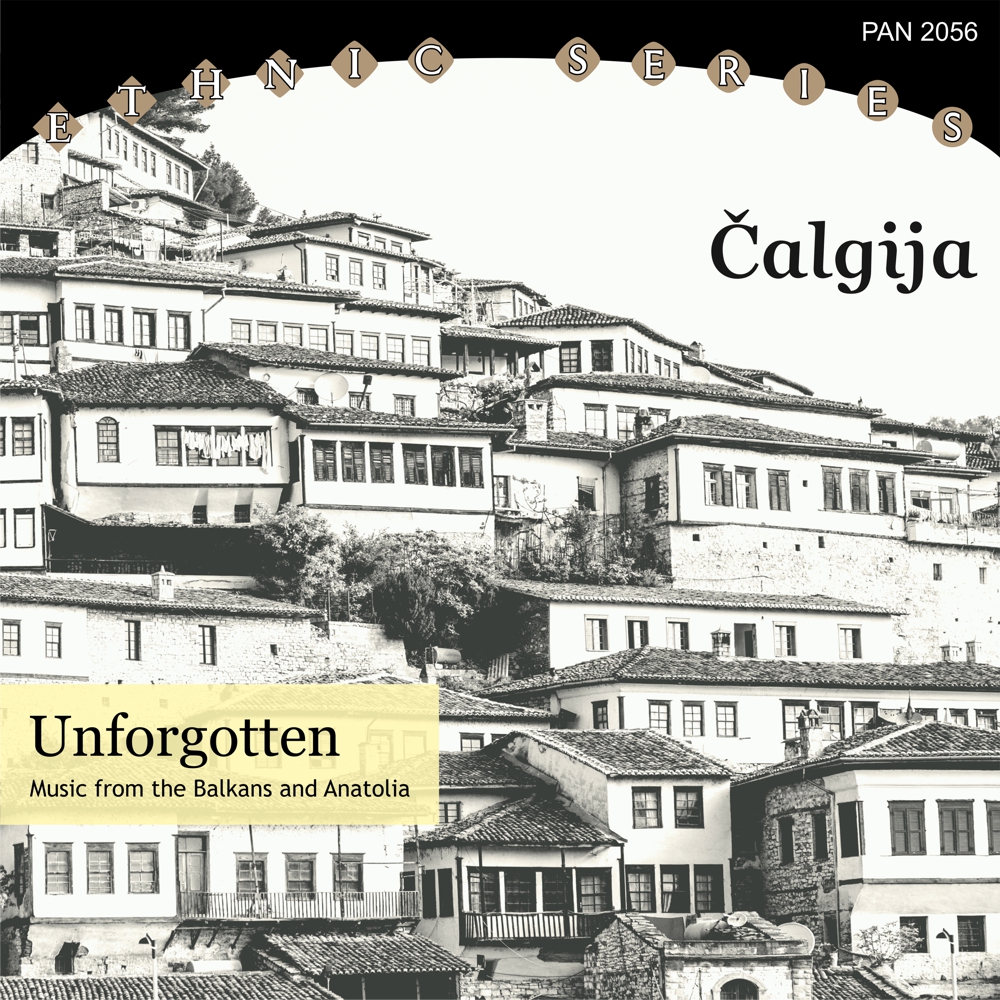
Album art / 1000 x 1000 px jpg
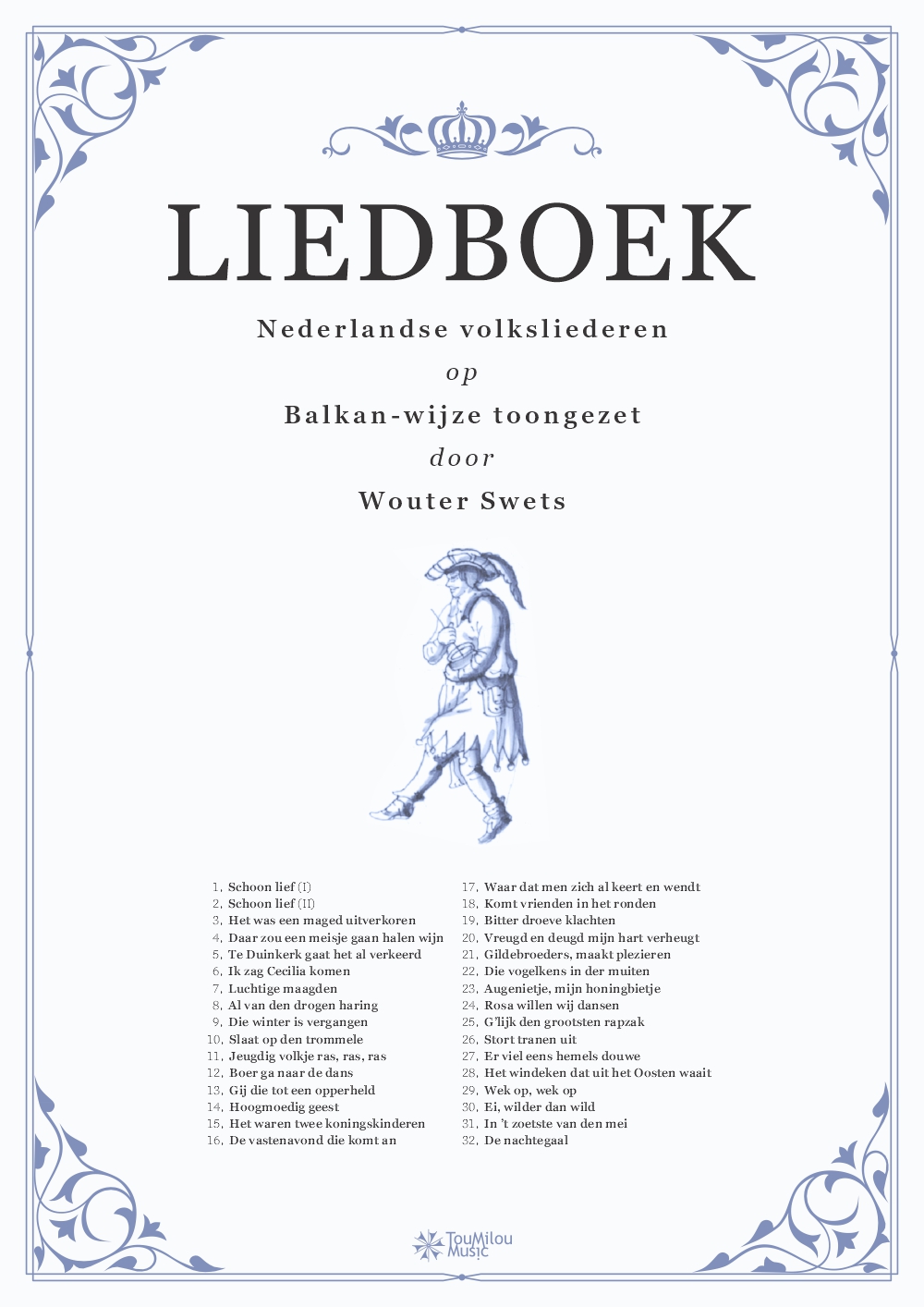
Scores / ‘Schoon Lief ‘ [17] and other Dutch songs / pdf
About the artwork
The album art features the Albanian city of Berat, nicknamed “Town of a Thousand Windows”, a UNESCO world heritage site renowned for its beautifully preserved Ottoman architecture. Front cover image: modification of a photo of the city by Olena Kachmar, reproduced under a 123RF Ltd Standard License). The scorebook cover image is taken from a 17th-century traditional Dutch wall tile, depicting a dancer with a rommelpot, a traditional friction drum.
Other releases by Čalgija
- Üçayak / TouMilou #5, 2021 / album
- Vintage Recordings (1964–1966) / TouMilou #2, 2017 / EP
- Mosaique Vivant / MV695, 1995 / compilation album with three tracks by Čalgija
- Music from the Balkans and Anatolia #2 / PAN 2007CD, 1991 / album
- Music from the Balkans and Anatolia #1 / MU 7425, 1978 / PAN 7425, 2013 / album

