
Kairos Collective | Európe
Contemporary modal music
Album information
Tracks / total playing time 58:18
- Hebros / Hüseynî karşılama
- Diaspora / Isfahân-Kürdî peşrev
- Dali znaeš pomniš Li / Κürdîli Hicâzkar Rumeli şarkı
- Nihâvend taksim / Improvisation on the cello
- Barbanera / Nihâvend evfer
- Hüseynî taksim / Improvisation on the oud
- Endülüs / Hüseynî-Aşîran yürük semâî
- Kairos / Stankina
- Manastırka / Poustséno / Pušteno
- Isfahân-Kürdî taksim / Improvisation on the violin
- Yol / Isfahân-Kürdî saz semâî
- Trandafirul rău tînjeşte / Doină
Credits
Musicians
Harris Lambrakis – ney
Giorgos Papaioannou – violin
Nikos Papaioannou – cello
Manolis Kanakakis – kanun
Taxiarchis Georgoulis – oud
Marijia Katsouna – bendir [1–3, 8, 11], pandeiro [5, 9], tombak [7]
Michiel van der Meulen – Macedonian tambura [1, 8, 9]
Special guests
Roel Sluis – vocals [3]
Vagelis Karipis – rek [11]
Albert van der Meulen – accordion [12]
Tracks
Tracks 1, 2, 5, 7, 8, 9 and 11 were composed by Michiel van der Meulen • Track 3 is an arrangement of a traditional North-Macedonian song by Wouter Swets and Michiel van der Meulen • Tracks 4, 6 and 10 are introductory improvisations • Track 12 is variation on a traditional Romanian song by Albert van der Meulen • Tracks 1–11 have been recorded by Nikos Kollias at Antart Studios (Athens, Greece) on January 8–11, 2019 • Track 12 is a home recording made by Remco Busink (Nieuwegein, Netherlands) in the 1980s • The album was mixed and mastered by Vangelis Apostolou (Studio Vasmaris).
Album
Production, artwork and liner notes – Michiel van der Meulen
Acknowledgements
Many thanks are due to: Ross Daly and Labyrinth Musical Workshop for guidance and inspiration • The musicians and studio staff for the great time we spent and the great job they did • Cengiz Arsanpay, Christos Barbas, Dominy Clements, Nikos Kokolakis, Dimitris Papageorgiou, Vassilis Phillipou, Magnus Robb, Goran Stalevski, Dorothy Strakari, Kelly Thoma, Sergios Voulgaris and Jan Wollring for advice and comments • Remco Busink for the recording of [12] • The Papaioannou family for their great hospitality during the recording sessions • Martine van der Meulen for love and understanding – this album is for you.
TouMilou #3 / EAN 8714835130574
© 2019 M.J. van der Meulen/TouMilou
Reviews and mentions
- Antione Bourgeau, Cahiers d’ethnomusicologie 36, 183–201 (2023; in French), discusses the album Pîrî Reis and the composition ‘Kairos’ (Európe) in an ethnomusicological analysis of contemporary modal music in terms of its origins, identity and mechanism of creativity, entitled ‘La circulation au cœur de la Contemporary Modal Music’.
- Marius Roeting, New Folk Sounds (November 20, 2019; translated from Dutch): “The performance standard is high, the transparancy of the various instruments excellent, and the compositions are challenging, captivating and imaginative. Van der Meulen deserves a statue!”
- Dani Heyvaert, Rootstime.be (July 1, 2019; translated from Dutch): “… the inventor of the most beautiful, sometimes unusual melodies that, once you have gotten used to them, find their way through your ears time and again, and may linger inside your head for days.”
- Holly Moors, Moors Magazine (June 25, 2019; translated from Dutch): “…genuinely new, modern European modal music, rooted in ancient European traditions. The unique musical voice of Michiel van der Meulen. Fabulous.”
Review of Európe in New Folk Sounds
Kairos Collective – Európe
Reviews / Mediterranean, modal music, Dutch composer / By Marius Roeting
I previously reviewed Pîrî Reis, the album by the ensemble led by the Dutch composer Michiel van der Meulen, in glowing terms. My only criticism was its rather short playing time. Van der Meulen seems to have taken that to heart, as this time he delivers an album lasting around an hour.
His compositions are performed by almost the same group of musicians: Harris Lambrakis (ney), Giorgos Papaioannou (violin), Manolis Kanakakis (kanun) and Marija Katsouna (percussion), joined by guest appearances from Nikos Papaioannou (cello), Albert van der Meulen (accordion), Vagelis Karipis (riq) and Roel Sluis (vocals). The composer himself also plays the tambura on several tracks.
There are few changes to the line-up, and the same applies to my verdict. Once again, this is music of the very highest calibre. Improvisation and modality lie at its heart, rather than melody for its own sake. The subtitle is once again Contemporary Modal Music, and not a word of that description is exaggerated. The entire album is built on modal principles, drawing on the Persian maqam tradition with a touch of Mediterranean influence. The result sounds strikingly authentic without ever becoming rigidly traditional or conventional.
Van der Meulen inherited both his love of music and his gift for composition. His father, Albert, was one of the pioneers of what was then regarded as the rather exotic music of Greece and the Balkans, alongside his mentor Wouter Swets (both members of Čalgija), and it was from him that Michiel first absorbed these musical traditions. He later refined his craft under Ross Daly, the acknowledged master of modal music. And with what results: it is remarkable that such richly idiomatic compositions should flow from the pen of an unassuming Dutchman. Even more remarkable is his ability to assemble exactly the right musicians to bring them to life.
The performance standard is high, the transparancy of the various instruments excellent, and the compositions are challenging, captivating and imaginative. Van der Meulen deserves a statue!
© 2019 New Folk Sounds
Review of Európe in Rootstime
Kairos Collective – Európe
A theatre company? An online interiors and design shop? Those are just two of the places you might end up if you search the web for The Kairos Collective. Fortunately, about eighteen months ago I had the pleasure of reviewing Pîrî Reis, so the penny dropped the moment I put this CD into the player and heard the opening notes of ‘Hebros’. This was unmistakably the music of Michiel van der Meulen, the man who has made contemporary modal music something of his life’s work, and whose Pîrî Reis turned out to be, by quite some margin, the album most frequently played in the Heyvaert household last year.
Now that this new album has been with me for a few weeks, it seems destined to follow the same path. If you sit down with the accompanying booklet, you might, as an untrained listener, come away feeling rather too ignorant to understand what this music is all about. But while you may not be formally trained, you can still be an experienced listener—and then you simply hear what the booklet cannot quite explain. Or at least, what the more technical sections, dealing with scales, tonal centres and the maqam modal system, struggle to convey. In the opening pages of the notes, Michiel reflects on Europe’s place in today’s world and explains why he chose Europe as the album’s title.
Our beautiful continent is wonderfully situated: travel a relatively short distance in almost any direction and you find yourself in an entirely different world. This is the Europe that is ideally placed to be a meeting point, a place of connection and exchange. Yet politically it has expanded too quickly in too short a time and, perhaps for that very reason, has elected leaders who prefer building walls to bridges, excluding people rather than welcoming them, and asking us to entrust them with power that they have no intention of sharing.
The parallel with the myth of the Phoenician princess Europa is obvious. She was seduced by Zeus, who had transformed himself into a gentle bull, carried off on his back to Crete, raped there, and ultimately abandoned. And so we arrive in Crete, where we also find the musical heart of this album. Európe is conceived as a tribute to the three people who taught Michiel to love music. First comes his father, Albert, an accordionist who also appears on the album in the closing track, Trandafirul Rău Tânjește. Then there is the music teacher and ethnomusicologist Wouter Swets, who taught Albert van der Meulen and, more importantly, introduced Dutch audiences to the music of the Balkans and the Middle East through his ensemble Čalgija. The third figure is, inevitably, Ross Daly, the musician who revealed the world of modal music to an entire generation of listeners and who is based on Crete. Hence the connection.
Michiel composed the vast majority of the music himself and performs it with a group of close Greek musical friends, recording almost everything live. What he presents is, quite simply, the musical story of everything he has learned over the years. Different people and different places have each contributed something to the composer he has become today: the inventor of the most beautiful, sometimes unusual melodies that, once you have gotten used to them, find their way through your ears time and again, and may linger inside your head for days.
When I reviewed the previous album, I described it as “beauty by the yard”, and that is no less true here. Believe me when I say that you are unlikely to hear more beautiful music than this at the moment. Admittedly, the album asks something of its listener. It requires a degree of empathy and openness. But it is so utterly convincing that, after only a few listens, it has you completely under its spell. Unlike some of the leaders we elect, however, this is music that reminds us that sharing and caring belong together. A masterpiece!
(Dani Heyvaert)
© 2019 Rootstime
Review of Európe in Moors Magazine
Kairos Collective
Európe / Contemporary modal music
Michiel van der Meulen loves Europe—the continent where travelling a thousand kilometres in almost any direction can bring you to an entirely different world, where cultures meet, connect and enrich one another, and where remarkable things happen. It is a continent that can effortlessly absorb and embrace even more influences. It was this vision of Europe that inspired him to create the album Európe, in which the right music and an open mind come together.
The album is also a tribute to three people who have been of great importance to Van der Meulen. First, his father, Albert van der Meulen, with whom he played from an early age and who introduced him to the music of Eastern Europe. Then there is the musician and ethnomusicologist Wouter Swets, who introduced Dutch audiences to the music of the Balkans and the Middle East and educated two generations of musicians in those traditions. Finally, there is the master musician and composer Ross Daly, whose seminars on modal composition proved to be the missing piece of the puzzle. That was when everything fell into place.
Európe presents contemporary modal music composed by Van der Meulen and recorded with Greek musicians: genuinely new, modern European modal music, rooted in ancient European traditions. The unique musical voice of Michiel van der Meulen. Fabulously beautiful.
- Kairos Collective – Európe – TouMilou Records – distributed by Xango
- Order the CD online
© 2019 Moors Magazine
Get the album
- Digital album on Bandcamp: € 7.00
- CD on Bandcamp: € 10.00
- The physical album can also be purchased from the distributor Xango Music and resellers such as bol.com and amazon.com
Bandcamp is an online platform that allows you to buy music directly from the people who make it. Unlike other channels, most revenue goes to the makers. Independent artists need independent listeners!
Downloads / Terms of use in the footer
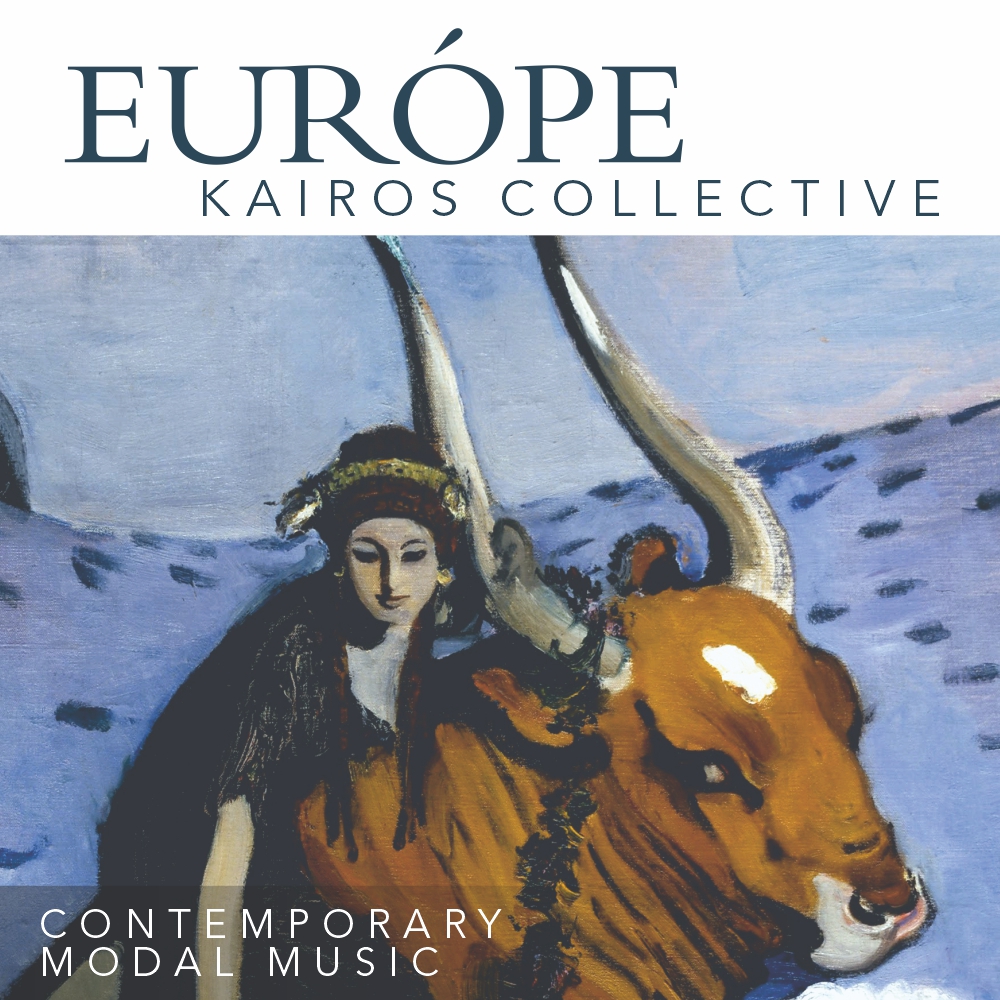
Album art / 1000 x 1000 px jpg
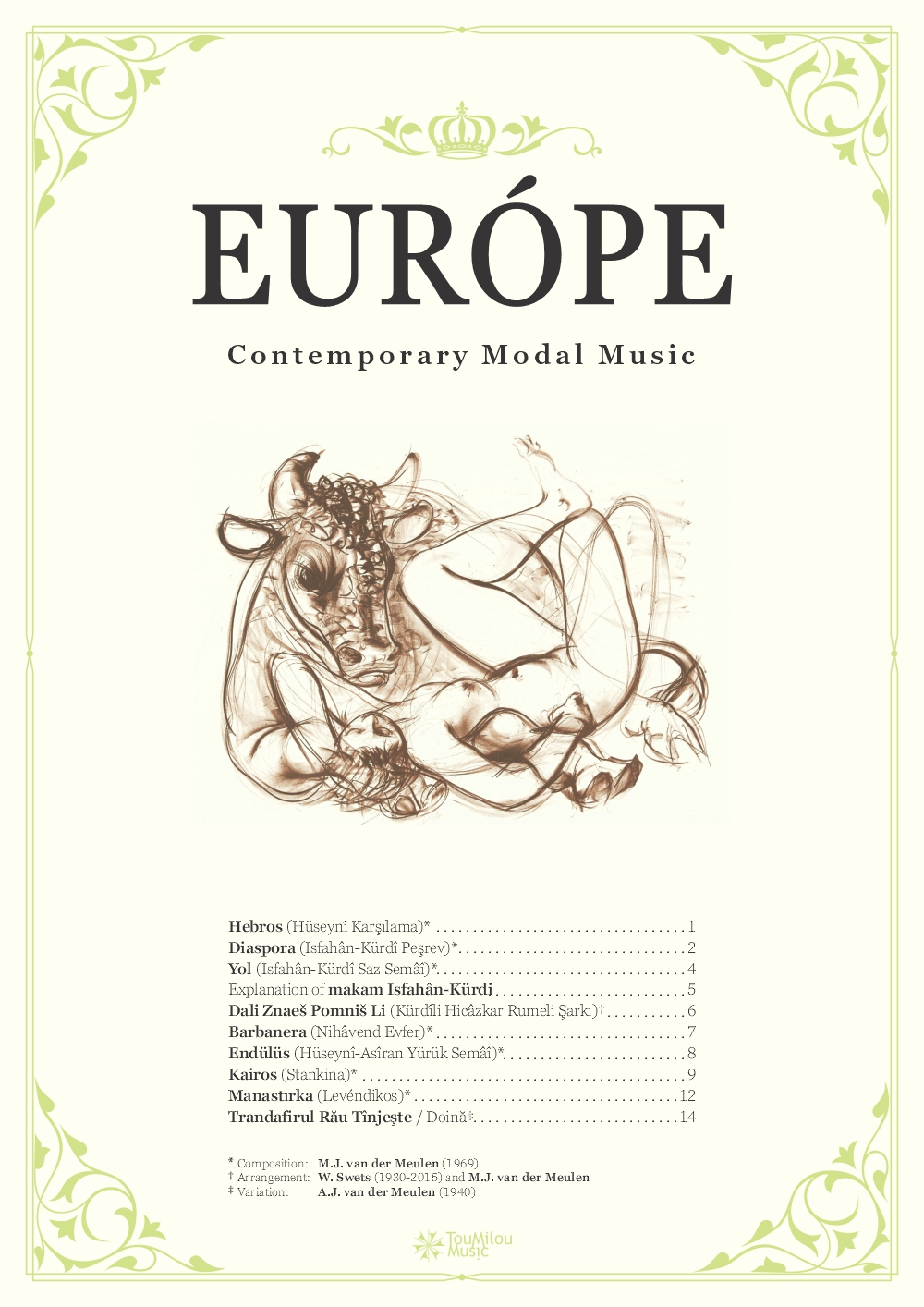
Scores / pdf
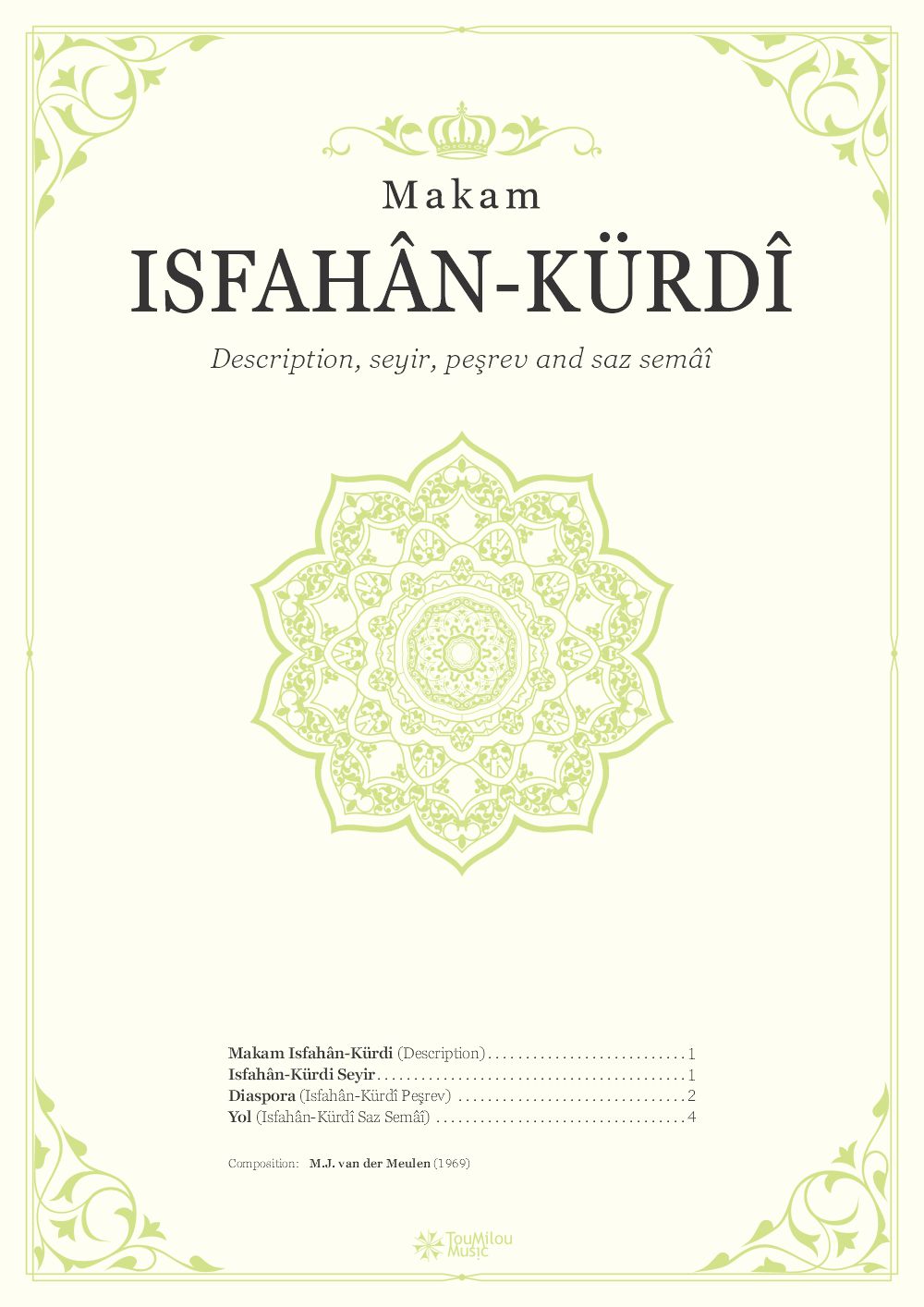
Makam description / pdf
About the artwork
In Greek mythology, Európe was a Phoenician princess who caught the eye of Zeus while she was playing at the beach. He transformed himself into a tame bull in order to escape the attention of his wife Hera and disguise himself for Európe. Európe caressed the bull en eventually got onto his back. He then took her into the sea and swam all the way to Crete. Upon arrival, Zeus made himself known to Európe and seduced her, after which she had three children: Minos (the later king), Rhadamantus and Sarpedon. The album artwork and score book feature the paintings ‘The Abduction of Europe’ (1910) by Valentin Serov (1865–1911), and the lithography ‘Europa’ (1953) by Hans Erni (1909–2015), respectively. Erni’s painting is copyright-protected and has been reproduced with permission from the rightholders.


