
Kairos Collective | Erato
Contemporary modal music
Album information
Tracks / total playing time 1:07:27
- Crimson / Nihâvend saz semâî
- Blackcap / Albanian folk melody
- Kilim / Janino
- Meltem / Hüseynî karşılama
- Erato / Acem-Bûselik medhal
- Muhayyer taksîm / Improvisation on the kanun
- Sapor / Muhayyer peşrev
- Manastırka / Poustséno / Pušteno
- Phoenix / Kürdî devr-i hindî
- Şivenüma taksîm / Improvisation on the violin
- Erebos / Şivenüma peşrev
- The Rose and the Nightingale / Phrygian phantasy
- Romanza / Acem Aşîrân saz semâî
- Aj Sarajevo / Nihâvend yürük semâî / Bojerka
Credits
Musicians
Harris Lambrakis – ney [1, 2, 7–9, 11–13]
Giorgos Papaioannou – violin [1, 2, 7, 9, 10–13]
Nikos Papaioannou – cello [1, 2, 7, 9, 11–13]
Manolis Kanakakis – kanun [1, 2, 6, 7, 9, 11–13]
Taxiarchis Georgoulis – oud [1, 2, 7, 9, 11–13]
Marijia Katsouna – bendir [1, 2, 7, 11, 13], tombak [12]
Michiel van der Meulen – tambura [2–4, 8], double bass [14]
Michalis Kouloumis – violin [3, 4, 8]
Special guests
Ross Daly – tarhu [5]
Kelly Thoma – lyra [5]
Mayu Shviro – cello [5]
Vagelis Karipis – bendir, rek [9]
Jan Wollring – accordion [14]
Tracks
Tracks 1, 3–5, 7–9 and 11–14 were composed by Michiel van der Meulen • Track 2 is an arrangement of an Albanian folk melody • Tracks 6 and 10 are improvisations • Track 9 was recorded by Nikos Kollias at Antart Studios (Athens, Greece) on June 22, 2020; 3, 4 and 8 by Udo Pannekeet at Wedgeview Studios (Woerdense Verlaat, Netherlands) on November 21, 2020; 14 in the same studio on July 21, 2021; 5 by Vangelis Apostolou at Studio Vasmaris (Heraklion, Greece) on August 27, 2021; and 1, 2, 7, the finale of 9, and 10–13 by Nikos Kollias at Antart Studios on May 22–24, 2022 • A few corrective overdubs were recorded by Cengiz Arslanpay at his home studio (Utrecht, Netherlands) on June 26, 2022, and Nikos Paraoulakis at Studio K65 (Athens, Greece) on July 16, 2022 • The album was mixed and mastered by Vangelis Apostolou at Studio Vasmaris between May 26 and November 2, 2022.
Album
Production, artwork and liner notes – Michiel van der Meulen
Acknowledgements
Many thanks are due to: Ross Daly and Labyrinth Musical Workshop for guidance and inspiration • The musicians and studio staff for the great time we spent and the great job they did • Evgenios Voulgaris for inspiring the arrangement of Romanza and his advice on the essence of a big sound • Sergios Voulgaris for advice on devr-i kebîr rhythmic patterns for bendir • Cengiz Arslanpay for explaining metaphors in Ottoman poetry • Pavlos Spyropoulos for lending us his double bass • Remco Busink for modifying our tambura • Sven van der Gijp for extending Kairos Collective to the Netherlands • The Theocharopoulou-Orfanidis and Papaioannou families for hospitality during the Greek recording sessions and friendship in general • My family and inlaws for their generous support of the project • Dominy Clements for proofreading the liner notes • Martine van der Meulen for love and understanding – this album is, as always and more than ever, for you.
TouMilou #6 / EAN 8714835139188
© 2022 M.J. van der Meulen/TouMilou
Reviews and mentions
- Dani Heyvaert, Rootstime.be (July 29, 2023; translated from Dutch): “A magnificent listening experience of over one hour, and an encounter with a way of making music that probably differs from what you are used to, but, believe me, you are bound to fall in love with!”
- Erato remained on the Balkan World Music Chart of the first quarter of 2023.
- The third episode of Folkit Mediterranee (a world music program on the Concertzender radio station) was dedicated to the works of Michiel van der Meulen, featuring tracks from Erato and preceding albums Európe and Pîrî Reis (April 28, 2023, in Dutch).
- Marius Roeting, New Folk Sounds (February 7, 2023; translated from Dutch): “There are no vocals to be heard, but the richness of the music is accomplished by the sounds and performance of the collective. Another grand product by a Dutch genius, played by outstanding (Greek) musicians.”
- In Februari 2023, Mundofonias (a Spanish World music station with a global reach) nominated Erato as one of three favorite albums of the month.
- Erato rose to the Transglobal World Music Chart (a global Top40 of world music releases) in February 2023.
- Erato made it to the Balkan World Music Chart of the fourth quarter of 2022.
- Lex Bohlmeijer, Passaggio Late Night (NPO Radio 4; January 10, 2023; in Dutch): “A fantastic Hollandse Nieuwe!, this is a truly remarkable adventure” (see below).
- Roger Holdsworth, Global Village (PBS-FM, Melbourne, Australia; January 1, 2023): “…a lovely new album from the Kairos Collective. The beautiful modal music is composed by Dutch bassist Michiel van der Meulen.”
- Kutay Derin Kuğay, Music of the World İstanbul (Açık Radyo; December 31, 2022; in Turkish): “…remarkable albums such as Erato by Kairos Collective […]. All of them are brilliant new releases.”
- Ross Daly, Labyrinth Musical Workshop (December 14, 2023): “This collection of compositions has my very very highest recommendation as one of the finest works that I have heard in many years.”
- Jan Willem Broek, De Subjectivisten (November 28, 2022; translated from Dutch): “Where does this music come from? There is no clear-cut answer, Utrecht would be too simplistic, but it resulted in a fantastic, unparalleled World album.”
- Holly Moors, Moors Magazine (November 13, 2022; translated from Dutch): “This is more than simply music; you can almost smell the centuries that have served as its inspiration. Like its predecessors, this third album is one to treasure.”
Review of Erato in Rootstime
Kairos Collective – Erato
We have previously written at length about Pîrî Reis and Európe, the first two albums by the ensemble led by the Dutch composer Michiel van der Meulen, who specialises in contemporary modal music—that branch of music which, for the sake of simplicity, can be described as using scales, or modes, other than the familiar major and minor systems to organise melodies. The range of possible modes seems inexhaustible, and perhaps the best advice I can offer is simply this: listen for yourself. Before long, you will find yourself entering the world of the Dorian, Ionian, Phrygian, Lydian, Aeolian and Locrian modes. Put simply, whereas our familiar scale begins and ends on C, in other modes any note may serve as the tonal centre, which in turn changes the intervals between the notes that follow.
Van der Meulen has repeatedly demonstrated that he is a master of these alternative modal systems, and once again, after repeated listens to this new album, I realised that it is really just a matter of listening differently. The listener has to set aside what Western ears instinctively expect to hear. For Erato, Van der Meulen drew extensively on the insights he gained during a workshop with the great Ross Daly, centred on the question ‘where does this music come from?’ That question can refer both to the geographical origins of a piece of music and to the search for an answer to why certain images, sounds and melodies move us deeply, while others scarcely rise above what we perceive as ordinary or commonplace. It is a question that quickly leads into the realm of philosophy, but in the hands of masters such as Daly and Van der Meulen, that is no obstacle to creating music of self-evident beauty—music that inevitably reminds us that all music ultimately comes from people.
From people who make use of the natural qualities of sound, qualities that we only begin to perceive as beauty once rhythm, emphasis and tonality are added—elements that, to simplify matters somewhat, we might classify under the heading of inspiration. This may all sound rather weighty, but it does nothing to diminish the fact that Erato is an extraordinarily beautiful and deeply intriguing work. That is only fitting, given that Erato is the Muse of lyric poetry and love songs. Almost the entire album was recorded live in the studio, giving the performances an unmistakable sense of spontaneity. Add to this the composer’s fascination with an astonishing range of musical traditions—from Uyghur and Ottoman to Persian and Arab music—which he has studied and absorbed into his own musical language, and the result is, at times, nothing short of remarkable.
In an extensive essay on his website, Van der Meulen discusses each of the album’s fourteen compositions in detail. The text runs to a dozen pages, and quoting it at length here would take us too far afield—you really should read it for yourself. Don’t be put off by its level of detail: if you let the album play while you read, you’ll soon arrive exactly where you ought to be—a magnificent listening experience of over one hour, and an encounter with a way of making music that probably differs from what you are used to, but, believe me, you are bound to fall in love with!
(Dani Heyvaert)
© 2023 Rootstime
Review of Erato in New Folk Sounds
Kairos Collective – Erato
Reviews / Greek, modal music, Dutch composer / By Marius Roeting
While we in the Netherlands continue to search for our own musical identity, we seem to thrive when it comes to music from beyond our borders. Take the Kairos Collective, for example: they have already produced several outstanding albums, including Pîrî Reis and Európe. The music is performed by an international ensemble—made up largely of Greek musicians—but it is composed and orchestrated by the Dutch musician Michiel van der Meulen.
From the very first notes, you are captivated by the almost devotional quality that the musicians bring to both the music and its performance. The album is rooted in the philosophical question ‘where does music come from?’ Van der Meulen explains that scientists from many different disciplines concern themselves with this question, but that music is, above all, a form of human expression. It is shaped by many influences, among which one’s fellow musicians are of paramount importance. For that reason, the album was recorded live with all the performers playing together. To preserve the spontaneity of the performances, most pieces were recorded in a single take, with only a few requiring a second take. As a result, not everything is immaculate or clinically perfect: you hear incidental background noises and the occasional slipped note. Yet that magical moment of collaboration—the dedication, the joy and the shared musical spirit—has been captured in fourteen magnificent recordings.
Most of the programme consists of Van der Meulen’s own compositions, supplemented by an traditional Albanian piece and several improvisations by the musicians. The unifying thread is contemporary modal music: there are no functional harmonies, at most a sustained drone, while the musicians all play the same melody, often in rhythmic patterns that sound unfamiliar to Western ears. These melodies are performed on instruments such as the ney (flute), violin, cello, kanun (zither), oud (lute) and a variety of percussion instruments, including the bendir and tombak. At times the music has a weight and gravity to it, while elsewhere it feels light-footed and buoyant, as in the cheerful ‘Kilim’.
The title track, ‘Erato’, is something of an outlier, but a delightful one. It is performed by Ross Daly, one of the leading masters of contemporary modal music. On this occasion he plays not the lyra but the tarhu, a modern bowed bass instrument inspired by the lyra. Kelly Thoma performs on the Cretan lyra, while Mayu Shviro adds the cello. The result is both a moment of repose and one of the album’s most intense listening experiences. A very different sonic palette—leaning more towards the Balkans than the Eastern Mediterranean—emerges in ‘Aj Sarajevo’, where Jan Wollring’s accordion takes the lead, supported by Van der Meulen on double bass and Jacobus Thiele on percussion.
There are no vocals to be heard, but the richness of the music is accomplished by the sounds and performance of the collective. Another grand product by a Dutch genius, played by outstanding (Greek) musicians.
An extensive track-by-track commentary can be found at: https://toumilou.nl/kairos-collective-erato/erato-liner-notes/
© 2023 New Folk Sounds
Review of Erato in De Subjectivisten
NNM: Kairos Collective – Erato
NNM is a series in which we review new music by Dutch artists.
Kairos Collective – Erato (cd, TouMilou Records)
Composer and multi-instrumentalist Michiel van der Meulen has devoted many years to what he calls contemporary modal music. Modal music is an inheritance from the Ottoman Empire and does not follow the familiar major and minor tonal systems. Van der Meulen was introduced to the related musical traditions of Greece and the Balkans from an early age by his father Albert, who, together with his mentor Wouter Swets, pioneered what was then regarded as the rather exotic music of Greece and the Balkans with the ensemble Čalgija. It was not long before Michiel himself became captivated by these traditions. He later studied on Crete with the Irish ethnomusicologist Ross Daly, where he mastered the system of melodic modes (maqam) found in traditional Arabic music. He has performed as a violinist with the ensemble Ano Kato and also founded the Kairos Collective. The group has already released the albums Pîrî Reis (2016) and Európe (2019) on Van der Meulen’s own independent—and idiosyncratic—label, TouMilou, which has also brought long-forgotten recordings by Čalgija back into circulation. In ancient Greek mythology, Kairos is the personification of the opportune moment—the right time to act or seize an opportunity—and symbolises inspiration and creative energy. The name aptly reflects the collaborative recording sessions, during which ideas are exchanged with passion at precisely the right moment, creating opportunities for something entirely new to emerge.
Now those intensive collaborations have produced a third album, Erato. Erato is one of the nine Muses of Greek mythology. Her name means “the lovely one”, and she is the Muse of hymns, song and lyric poetry, traditionally associated with stringed instruments. This new album is dedicated to the source of music itself—or, as the great Ross Daly once posed in a seminar entitled Where Does This Music Come From? The question is not merely philosophical. Music can often be traced back to particular geographical regions, although its origins frequently prove more surprising than one might expect. At the same time, music also comes from within ourselves. But how did it get there? Why am I so deeply moved by Turkish and Arab music, while someone else feels nothing at all?
Van der Meulen (composition, tambura and double bass) and his collective explore these questions across fourteen pieces that illuminate the theme with remarkable imagination. The source itself becomes a kind of muse for the act of making music. To realise this project, he worked with Harris Lambrakis (ney), Michalis Kouloumis (violin), Giorgos Papaioannou (violin), Nikos Papaioannou (cello), Manolis Kanakakis (kanun), Taxiarchis Georgoulis (oud), Alexandros Papadimitrakis (oud), Marijia Katsouna (bendir, tombak) and Jacobus Thiele (adufe, daire, bendir and drums). Five guest musicians also make appearances on tarhu, lyra, cello, bendir, ney and accordion.
The music is entirely instrumental, yet it carries the listener on a compelling and evocative journey through lands of long ago, while presenting them in an unmistakably contemporary guise. Or perhaps it is better described as new music expressed through ancient means. It breathes history—so vividly that it seems almost tangible, almost perceptible by scent—yet at the same time belongs entirely to the present. Chronology simply ceases to matter. Instead, immerse yourself in this timelessly beautiful music, enriched by a wonderfully melancholy patina. You are unlikely to encounter anything quite like it elsewhere.
Where does this music come from? There is no clear-cut answer, Utrecht would be too simplistic, but it resulted in a fantastic, unparalleled World album.
Jan Willem Broek
© 2022 De Subjectivisten
Review of Erato in Moors Magazine
Kairos Collective
Erato / Contemporary modal music
Michiel van der Meulen is a composer and musician who has already surprised us several times with astonishingly beautiful albums of contemporary modal music of his own composition, drawing on the modal traditions of the vast Ottoman Empire. He recorded Pîrî Reis with five Greek musicians, resulting in a breathtakingly beautiful album. This was followed by the equally impressive Európe, on which Van der Meulen’s Kairos Collective once again explored the rich world of contemporary modal music.
This third album by the Kairos Collective centres on the source of music itself. Once again, it features Van der Meulen’s modal compositions, performed by the expanded ten-piece Kairos Collective, with magnificent guest appearances from Ross Daly and Kelly Thoma on the title track, ‘Erato’.
Of the album’s fourteen pieces, eleven are composed by Van der Meulen, one is an arrangement of an Albanian folk melody, and two are improvisations by violinist Giorgos Papaioannou and kanun player Manolis Kanakakis. The overall effect is that the listener is immersed in an entirely different world—a musical world that had seemed almost lost to time, yet has somehow become tangible, palpable and audible once more. This is more than simply music; you can almost smell the centuries that have served as its inspiration. Like its predecessors, this third album is one to treasure.
- Kairos Collective – Erato – Contemporary Modal Music – TouMilou Music
© 2022 Moors Magazine
Music Mosaic concerts / Houdetsi, Crete
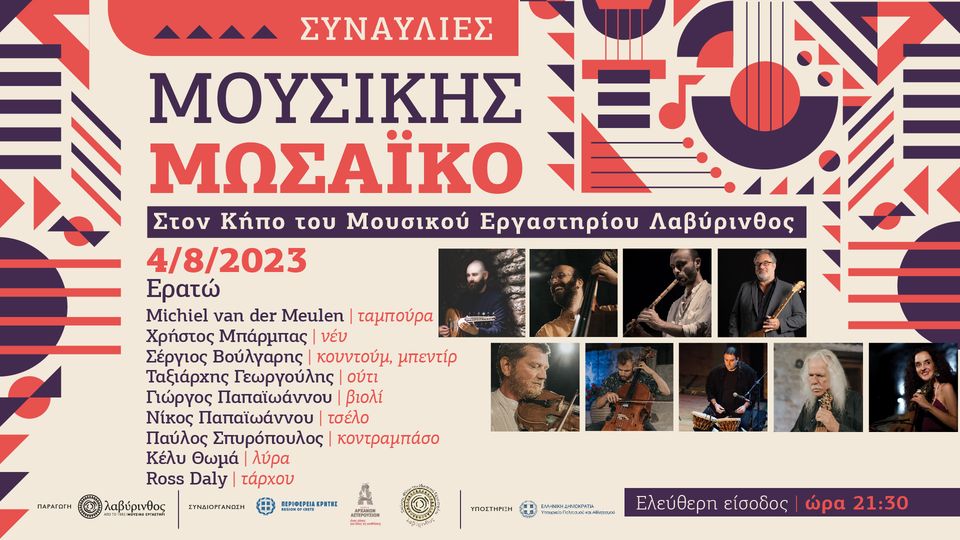
Erato was presented in Labyrinth Musical Workshop’s Music Mosaic concert series in Houdetsi, Crete, on August 4, 2023.
Musicians: Christos Barbas (ney), Giorgos Papaioannou (violin), Nikos Papaioannou (cello), Taxiarchis Georgoulis (oud), Michiel van der Meulen (tambura), Pavlos Spyropoulos (bass), and Sergios Voulgaris (kudüm, bendir, daire), with a special guest appearance of Ross Daly (tarhu) and Kelly Thoma (lyra).
Hollandse Nieuwe! / Featured release series
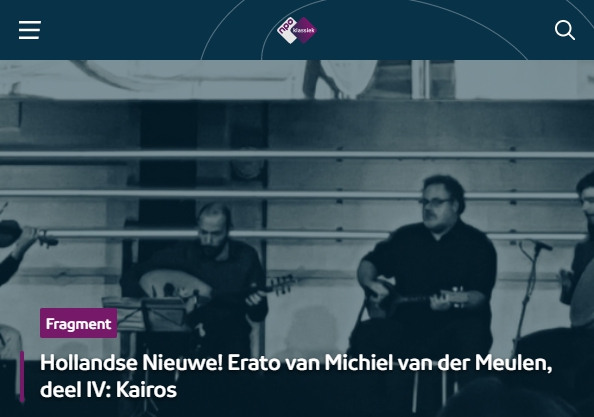
Erato was selected as the second Hollandse Nieuwe! of 2023, that is, featured for a week on NPO Klassiek in the radio programs Passaggio Late Night (weekdays) and Vrije Geluiden (weekend): two tracks per day combined with fragments of an interview (in Dutch).
Get the album
Bandcamp is an online platform that allows you to buy music directly from the people who make it. Unlike other channels, most revenue goes to the makers. Independent artists need independent listeners!
Downloads / Terms of use in the footer
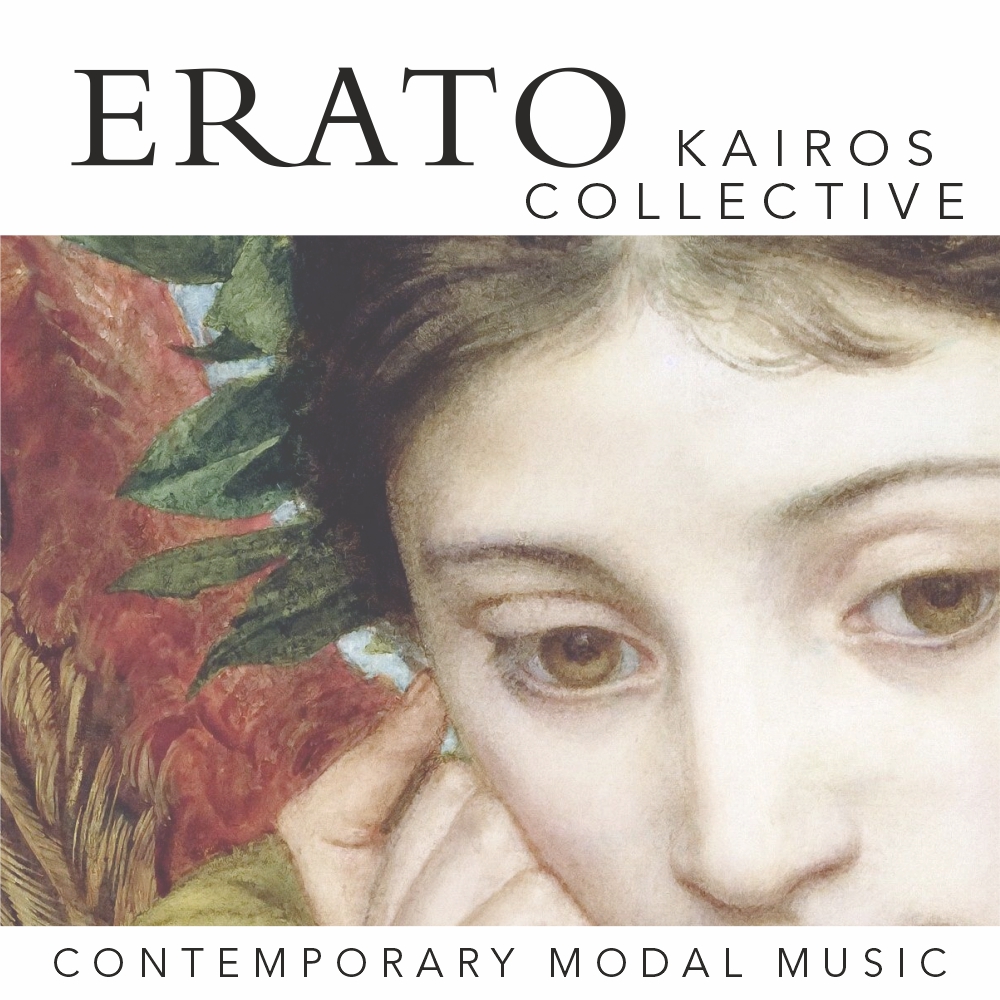
Album art / 1000 x 1000 px jpg
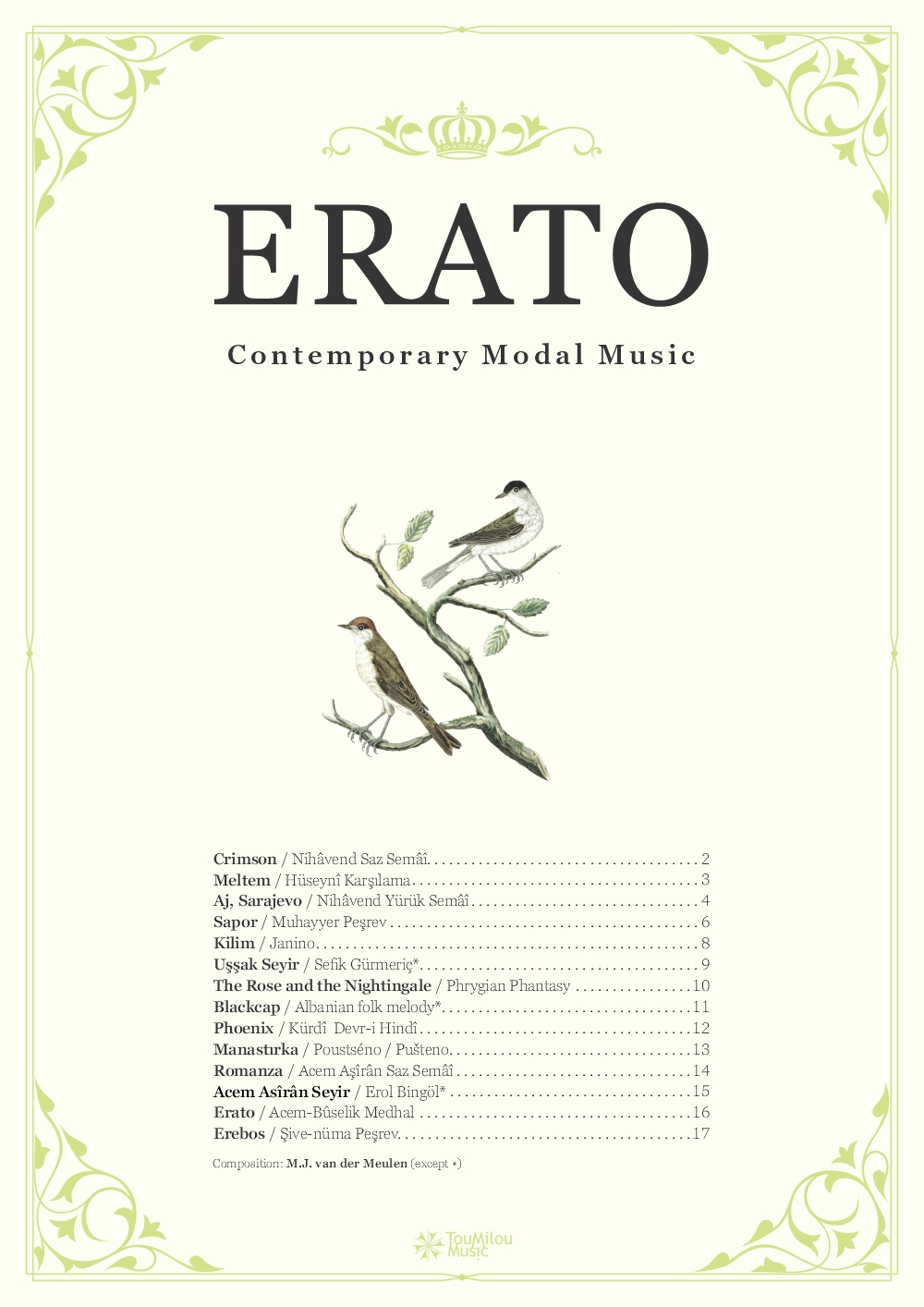
Scores / pdf
About the artwork
Sir Edward John Poynter (Paris, 20 March 1836 – London, 26 July 1919), was an English painter and draughtsman with a long and distinguished career that earned him a knighthood and an honorary Cambridge degree in 1898, and a baronetcy in 1902. His ‘Erato, Muse of Poetry’ (1870, watercolour on paper, 47 x 33 cm) is more chaste and delicate than the generally voluptuous, exalted, Baroque to Romantic-era depictions. Apart from the fact that she is winged, Poynter’s Erato is a mythologically faithful represention of the muse of love poetry, which I chose because of the beauty of the eyes.
The artwork of the scores book is from Nederlandsche Vogelen (Birds of the Netherlands) by Cornelis Nozeman and Christiaan Sepp, the monumental, beautifully illustrated, five-part first Dutch avifauna, which appeared between 1770 and 1829.


